Showing posts with label addition. Show all posts

Sunday, October 3, 2010

Climb the Ladder!

Danylle, the 4th grade teacher at Hedog, is concerned about her students' fluency with base-10 concepts. We dug out her Kathy Richardson "Understanding Numbers: Place Value" kit and put together an effective (We hope!) set of activities for Menu.

It was funny, though, because our planning session began with me giving her an impromptu idea that seemed great at first, (Don't they all? Ha!) but looked more and more shabby the deeper we went into Kathy's materials.

Danylle proved her worth as a teacher, though, with unflagging encouragement! "I like your idea, Chris," she said. "I'm going to still use it."

Uh huh.

I left Hedog that afternoon determined to craft this idea into an activity that would produce results, and wouldn't look pitiful next to the other Menu items. I happened across some "Climb the Ladder" activities while browsing Mathwire.

Climb the Ladder was just the touch I needed! So I'm happy to share with you an activity that requires only a deck of digit cards and a work some activity sheets. This should be good for latter year second graders, third graders, and 4th graders who need further support or practice.

Note: The directions ask students to represent their number using squares, lines, and dots. This vocabulary was chosen for simplicity. These representations should be connected with the flats, rods, and cubes of the base-10 blocks, or to the sheets, strips, and singles of the Sticker Station.

Have fun!
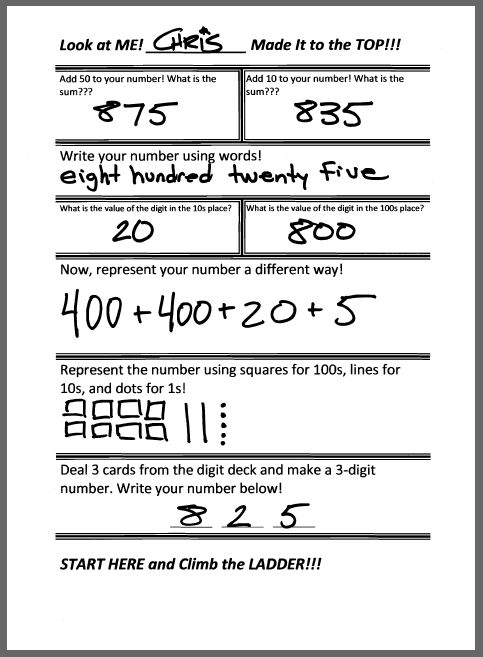

Download: Climb the Ladder Base-10 and Place Value Concepts

Friday, September 17, 2010

Non Linguistically Speaking

When students struggle to interpret story problems into a mathematical statement they can tackle and solve, a nonlinguistic representation may lead to success. Explicitly engaging students in the creation of lonlinquistic representations increases activity in the brain (Gerlic & Jausovec, 1999)

Language challenged 3rd graders might find this problem difficult to navigate:

Riverside School had 517 students last year. This year, 60 students moved away before school started. How many students does the school have now?

A nonlinguistic representation to help students create a mental picture of, and organize, the essential information.

TOTAL
PartPart


Substituting the information from the problem, our representation becomes:

517 students (Total)
60 students (Part) Part

Using this representation, it is perhaps clearer to students that they are looking for the difference between 60 and 517. They could then solve the problem in one of two ways: by counting on from 60, or by subtracting 60 from 517.

Thursday, September 9, 2010

What Do Third Graders Know About Addition?

Mr. Birch's third graders have been putting together a list of statements they believe to be true about addition. Here is what they have so far:

What do we know about addition?

1.  Numbers usually get larger.

2.  You are putting things together.

3.  Adding sign is +

4.  Find the total.

5.  How many all together?

6.  What is the sum?

7.  Addends can be added up in any order to the sum.

8.           7   ----addend ------     5
            +5   --- addend ------- + 7
           12  ----  sum     -------  12

What do other third graders think about this list? If you'd care to add something, or have any questions for us, please leave a comment!


I have a question about the first item on their list. Mr. Birch's students suggest that numbers usually get larger with addition. Can you give an example of when the sum gets smaller???

Spring Creek Mathematicians Tell Addition Stories!


8 Sleeping Billy Goats + 2 Billy Goats Playing from (Chris) on Vimeo.

Mathematics is about far more than numbers - and certainly must include more than lists of rules. In her book What's Math Got to Do With It?, Jo Boaler describes math as
a human activity, a social phenomenon, a set of methods used to help illuminate the world
 Second graders at Spring Creek are exploring how mathematics can be used to illustrate simple stories. More specifically, they are crafting stories involving combinations of 10. Perhaps you can tell what time of day these were recorded by all the references to sleep.  /grin